Thursday, November 24, 2016

Dynamic Programming in 5 easy steps - Examples - Two Robots

Please find the updated version of this post here: https://piotr.westfalewicz.com/blog/2016/11/dynamic-programming-in-5-easy-steps---examples---two-robots/


This time we will solve a HackerRank problem, rated as a medium in difficulty. It's advised for you to go through a similar, but in my opinion easier problem described by me previously. The problem statement is as follows:
You have a warehouse with M containers filled with an infinite number of candies. The containers are arranged in a single row, equally spaced to be 1 meter apart. You also have 2 robots that can pick up 1 piece of candy and transport it between any two containers.

The robots take instructions in the form of queries consisting of two integers, Ma and Mb, respectively. To execute a query, a robot travels to container Ma, picks up 1 candy, transports it to container Mb, and then stops at Mb until it receives another query.

Calculate the minimum total distance the robots must travel to execute N queries in order.

Note: You choose which robot executes each query.
Reminder -  the 5 easy steps are:
  1. define subproblems, count number of subproblems
  2. guess (part of solution), count number of choices
  3. relate subproblem solutions, compute time per subproblem
  4. recurse + memoize OR build DP table bottom-up check subproblems acyclic/topological order, time = time per subproblem · number of subproblems
  5. solve original problem: = a subproblem OR by combining subproblem solutions ⇒ extra time 
Step 1. Let's try to figure out what our subproblems are. At a given point in solving the problem, what information do we want to have? First obvious thing: index of queries. Next obvious thing: we want to optimize over total distance made by robots, therefore our DP function will return the minimum total distance made by robots at some point in our problem. Having that, we also probably will need positions of two robots. The situation looks like this:

Step 2. Now, we basically have two choices, A: proceed with the first robot or B: with the second robot. When A - we add the distance of moving the r1 from it's last place Mb(r1) to Ma(INDEX), otherwise B: we add the distance of moving the r2 from it's last place Mb(r2) to Ma(INDEX). Additionally, in both cases we have to add the cost of moving Ma(INDEX) to Mb(INDEX).
Step 3. Writing the DP function is now straightforward:

DP(r1, r2, index) = min from:
   A: Ma(INDEX) - Mb(r1) + Mb(INDEX) - Ma(INDEX) + DP(INDEX, r2)
   B: Ma(INDEX) - Mb(r2) + Mb(INDEX) - Ma(INDEX) + DP(r1, INDEX)
However, having the index in DP function is redundant. We can decrease the time complexity of our solution by removing it - index is always the next item after max(r1, r2). Thus, DP function now looks like:

DP(r1, r2) = min from:
   A: Ma(max(r1, r2)+1) - Mb(r1) + Mb(max(r1, r2)+1- Ma(max(r1, r2)+1) + DP(max(r1, r2)+1, r2)
   B: Ma(max(r1, r2)+1) - Mb(r2) + Mb(max(r1, r2)+1- Ma(max(r1, r2)+1) DP(r1, max(r1, r2)+1)

The number of subproblems equals to M*M, because that's how many states which in the robots can be arranged. Time of computing one subproblem is constant, therefore the final complexity of this solution is O(M2).
Step 4. So is it finite algorithm? Yes, because the graph is traversed through two increasing values, r1 and r2.
Step 5. The solution is in DP(-1, -1), assuming -1 denotes that the robot wasn't used yet and the cost of moving it to Mx is 0 (because it starts at this location).

The code

using System;
using System.Collections.Generic;
using System.Linq;

namespace Algos
{
 public class Solver
    {
        private readonly int _m;
        private readonly int _n;
        private readonly List> _queries;
        private int[][] _memo;

        public Solver(int m, int n, List> queries)
        {
            _m = m;
            _n = n;
            _queries = queries;
        }

        public int SolveCase()
        {
            _memo = new int[_n + 1][];
            for (int i = 0; i < _n + 1; i++)
                _memo[i] = new int[_n + 1];
            for (int i = _n; i >= 0; i--)
            {
                for (int j = _n; j >= 0; j--)
                {
                    _memo[i][j] = -1;
                }
            }

            return Dp(-1, -1);
        }

        private int Dp(int r1, int r2)
        {
            if (r1 + 1 == _n || r2 + 1== _n)
                return 0;
            if (_memo[r1 + 1][r2 + 1] != -1)
                return _memo[r1 + 1][r2 + 1];

            var i = Math.Max(r1, r2) + 1;
            //r1 stays in place
            var r2Cover = 0;
            if (r2 != -1)
                r2Cover = Math.Abs(_queries[r2].Item2 - _queries[i].Item1);
            var d1 = Dp(r1, i);
            //r2 stays in place
            var r1Cover = 0;
            if (r1 != -1)
                r1Cover = Math.Abs(_queries[r1].Item2 - _queries[i].Item1);
            var d2 = Dp(i, r2);

            var queryCover = Math.Abs(_queries[i].Item1 - _queries[i].Item2);
            var min = Math.Min(r2Cover + d1 + queryCover, r1Cover + d2 + queryCover);

            _memo[r1 + 1][r2 + 1] = min;

            return min;
        }
    }
 
    class Solution
    {
        static void Main(string[] args)
        {
            //CaseSub0();
            //Case0();
            //Case1();
            //Case2();
            //RandomBigCase();
            //return;

            var T = int.Parse(Console.ReadLine());
            for (var i = 0; i < T; i++)
            {
                ProcessCase();
            }
        }

        private static void ProcessCase()
        {
            var @case = Console.ReadLine().Split(new[] { " " }, StringSplitOptions.RemoveEmptyEntries);
            var M = int.Parse(@case[0]);
            var N = int.Parse(@case[1]);
            var queries = new List>(N);
            for (int i = 0; i < N; i++)
            {
                var query = Console.ReadLine().Split(new[] { " " }, StringSplitOptions.RemoveEmptyEntries);
                queries.Add(Tuple.Create(int.Parse(query[0]), int.Parse(query[1])));
            }
            var solution = new Solver(M, N, queries).SolveCase();
            Console.WriteLine(solution);
        }
  
  private static void CaseSub0()
        {
            var M = 2;
            var N = 1;
            var queries = new List>();
            queries.Add(Tuple.Create(1, 2));
            var solution = new Solver(M, N, queries).SolveCase();
            Console.WriteLine("Casesub0 " + solution);
        }

        private static void Case0()
        {
            var M = 5;
            var N = 4;
            var queries = new List>();
            queries.Add(Tuple.Create(1, 5));
            queries.Add(Tuple.Create(3, 2));
            queries.Add(Tuple.Create(4, 1));
            queries.Add(Tuple.Create(2, 4));
            var solution = new Solver(M, N, queries).SolveCase();
            Console.WriteLine("Case0 " + solution);
        }

        private static void Case1()
        {
            var M = 4;
            var N = 2;
            var queries = new List>();
            queries.Add(Tuple.Create(1, 2));
            queries.Add(Tuple.Create(4, 3));
            var solution = new Solver(M, N, queries).SolveCase();
            Console.WriteLine("Case1 " + solution);
        }

        private static void Case2()
        {
            var M = 10;
            var N = 3;
            var queries = new List>();
            queries.Add(Tuple.Create(2, 4));
            queries.Add(Tuple.Create(5, 4));
            queries.Add(Tuple.Create(9, 8));
            var solution = new Solver(M, N, queries).SolveCase();
            Console.WriteLine("Case2 " + solution);
        }

        private static void RandomBigCase()
        {
            var M = 1000;
            var N = 1000;
            var queries = new List>();
            var r = new Random(666);
            while (queries.Count != N)
            {
                var from = r.Next(1, M + 1);
                var to = r.Next(1, M + 1);
                var t = Tuple.Create(from, to);
                if (!queries.Contains(t))
                    queries.Add(t);
            }
            var solution = new Solver(M, N, queries).SolveCase();
            Console.WriteLine("RandomBigCase " + solution);
        }
    }
}

Monday, October 31, 2016

Dynamic Programming in 5 easy steps - Examples - Set partitioning

Please find the updated version of this post here: https://piotr.westfalewicz.com/blog/2016/10/dynamic-programming-in-5-easy-steps---examples---set-partitioning/


Let's continue Dynamic Programming series. Last time we have covered Text Justification problem, this time we will do something harder. The problem statement is as follows:
Given a set S of positive integers, divide it into two sets S1 and S2 such that the absolute difference between their sums is minimum.

If there is a set S with n elements, then if we assume S1 has m elements, S2 must have n-m elements and the value of abs(sum(S1) – sum(S2)) should be minimum.
The 5 easy steps are:
  1. define subproblems, count number of subproblems
  2. guess (part of solution), count number of choices
  3. relate subproblem solutions, compute time per subproblem
  4. recurse + memoize OR build DP table bottom-up check subproblems acyclic/topological order, time = time per subproblem · number of subproblems
  5. solve original problem: = a subproblem OR by combining subproblem solutions ⇒ extra time 
Taking an example, assume a set S={ 1, 6, 11, 5}.
Step 1. As previously, we want to divide the problem to subproblems.
How this can be done? Suffixes, prefixes or the mix of those two are usually the answer. It's natural to imagine that in the middle of processing the set looks at some point as follows .., 11, 5. At this very point we already assumed we are working on suffixes. 
In that situation we can either include the 11 in the set S1 or in the set S2. I'll say that we take or leave the number, because we have only two choices.
Related, very important aspect - we have to track only one sum! The other one is just totalSum-chosenSetSum.
Getting back to our situation, what is the "context" of the subproblem? Does it matter how we got to this point? Not at all, what matters is only the chosenSetSum. Obviously, we have to also keep track of our current item index. Here we have it, the subproblems.

Step 2. How our guess will look like? We can increase the sum and progress with the problem,
or we can just progress with the problem, assuming we leave the item and it will be in the second set.

Step 3. Now we have to glue two pieces togeter. Our DP function will have two arguments as noted above, chosenSetSum and index.
We want to optimize for the minimum difference between the sets and that's what will be returned by the DP function. All in all, the equation is as follows:
DP(chosenSetSum, i) = min from:
  • DP(chosenSetSum, i+1) //when skipping the i'th item
  • DP(chosenSetSum + inputSet[i], i+1)) //when taking the i'th item
The corner case is DP(X, inputSet.Length) = totalSum-X, because that's the end of partitioning.
The time complexity of this approach is:
time = time per subproblem · number of subproblems, so
time = O(1) * O(sum * n) = O(sum * n)
Yey, we have pseudo-polynomial time solution.

Step 4. Is it actually an acyclic graph of DP function invocations? My reasoning here is that we have two dimensions (chosenSetSum and item index) where both increase and there is an end when the second variable reaches input set cardinality, thus it's finite algorithm.

Step 5. We start with chosenSetSum=0 and at the first index, therefore our solution is at DP(0,0).

The Code

Having the 5 steps figured out, it's relatively easy to code the solution.

Pure DP algorithm coded without memorization

private class Partitioner
{
    private readonly int[] _inputSet;
    private readonly int _inputSetSum;

    public Partitioner(int[] inputSet)
    {
        _inputSet = inputSet;
        _inputSetSum = _inputSet.Sum();
    }

    public void Solve()
    {
        DP(0, 0);
    }

    private int DP(int chosenSetSum, int i)
    {
        if (i == _inputSet.Length)
            //Note: returning the difference between chosenSetSum and skippedSetSum, 
            //not the skippedSetSum (which would be _inputSetSum - chosenSetSum)
            return Math.Abs(_inputSetSum - 2 * chosenSetSum);

        var chooseCurrentNumberScore = DP(chosenSetSum + _inputSet[i], i + 1);
        var skipCurrentNumberScore = DP(chosenSetSum, i + 1);
        var minDiff = Math.Min(skipCurrentNumberScore, chooseCurrentNumberScore) ;

        return minDiff;
    }
}
How cool is that? 6 lines of code for almost working solution!

Memoization added

private class Partitioner
{
    private const int Marker = -1;
    private readonly int[] _inputSet;
    private readonly int _inputSetSum;
    private readonly int[][] _memo;

    public Partitioner(int[] inputSet)
    {
        _inputSet = inputSet;
        _inputSetSum = _inputSet.Sum();
        _memo = new int[_inputSetSum][];
        for (var i = 0; i < _inputSetSum; i++)
        {
            _memo[i] = new int[_inputSet.Length];
            for (var j = 0; j < _inputSet.Length; j++)
                _memo[i][j] = Marker;
        }
    }

    public void Solve()
    {
        DP(0, 0);
    }

    private int DP(int chosenSetSum, int i)
    {
        if (i == _inputSet.Length)
            //Note: returning the difference between chosenSetSum and skippedSetSum, 
            //not the skippedSetSum (which would be _inputSetSum - chosenSetSum)
            return Math.Abs(_inputSetSum - 2 * chosenSetSum);

        if (_memo[chosenSetSum][i] != Marker)
            return _memo[chosenSetSum][i];

        var chooseCurrentNumberScore = DP(chosenSetSum + _inputSet[i], i + 1);
        var skipCurrentNumberScore = DP(chosenSetSum, i + 1);
        var minDiff = Math.Min(skipCurrentNumberScore, chooseCurrentNumberScore);

        _memo[chosenSetSum][i] = minDiff;
        return minDiff;
    }
}

Full solution with parent pointers and examples

using System;
using System.Collections.Generic;
using System.Linq;

public class DP_SetPartition
{
    static void Main(String[] args)
    {
        PrintSolution(new int[0]);
        PrintSolution(new[] { 3 });
        PrintSolution(new[] { 3, 3 });
        PrintSolution(new[] { 3, 2 });
        PrintSolution(new[] { 1, 4, 2 });
        PrintSolution(new[] { 1, 2, 4 });
        PrintSolution(new[] { 1, 1, 5, 1, 1, 1 });
        PrintSolution(new[] { 1, 6, 11, 5 });
        PrintSolution(new[] { 1, 6, 11, 5 });
        PrintSolution(new[] { 25, 21, 20, 17, 8 });
        PrintSolution(new[] { 1, 5, 6, 10 });
        PrintSolution(new[] { 3, 1, 4, 2, 2, 1 });
        PrintSolution(new[] { 200, 200, 300, 300, 400, 400, 1000, 1000 });
        PrintSolution(new[] { 100, 100, 200, 200, 300, 300, 400, 400, 1000, 1000 });
        Console.ReadLine();
    }

    private static void PrintSolution(int[] set)
    {
        Console.WriteLine($"Set: {string.Join(", ", set)}");
        int[] set1;
        int[] set2;
        new Partitioner(set).Solve(out set1, out set2);
        Console.WriteLine($"A: {string.Join(", ", set1)} \t\t B: {string.Join(", ", set2)}, sumdiff: {Math.Abs(set1.Sum() - set2.Sum())}");
        Console.WriteLine();
    }

    private class Partitioner
    {
        private const int Marker = -1;
        private readonly int[] _inputSet;
        private readonly bool[][] _parentPointers;
        private readonly int _inputSetSum;
        private readonly int[][] _memo;

        public Partitioner(int[] inputSet)
        {
            _inputSet = inputSet;
            _inputSetSum = _inputSet.Sum();
            _memo = new int[_inputSetSum][];
            _parentPointers = new bool[_inputSetSum][];
            for (var i = 0; i < _inputSetSum; i++)
            {
                _memo[i] = new int[_inputSet.Length];
                _parentPointers[i] = new bool[_inputSet.Length];
                for (var j = 0; j < _inputSet.Length; j++)
                {
                    _memo[i][j] = Marker;
                }
            }
        }

        public void Solve(out int[] set1, out int[] set2)
        {
            DP(0, 0);
            var chosenSet = new List<int>();
            var skippedSet = new List<int>();
            var sum = 0;
            var i = 0;
            while (i != _inputSet.Length)
            {
                var choose = _parentPointers[sum][i];
                if (choose)
                {
                    chosenSet.Add(_inputSet[i]);
                    sum += _inputSet[i];
                }
                else
                {
                    skippedSet.Add(_inputSet[i]);
                }
                i++;
            }
            set1 = chosenSet.ToArray();
            set2 = skippedSet.ToArray();
        }

        private int DP(int chosenSetSum, int i)
        {
            if (i == _inputSet.Length)
                return Math.Abs(_inputSetSum - 2 * chosenSetSum);

            if (_memo[chosenSetSum][i] != Marker)
                return _memo[chosenSetSum][i];

            var chooseCurrentNumberScore = DP(chosenSetSum + _inputSet[i], i + 1);
            var skipCurrentNumberScore = DP(chosenSetSum, i + 1);
            var minDiff = skipCurrentNumberScore;
            if (chooseCurrentNumberScore < skipCurrentNumberScore)
            {
                minDiff = chooseCurrentNumberScore;
                _parentPointers[chosenSetSum][i] = true;
            }

            _memo[chosenSetSum][i] = minDiff;
            return minDiff;
        }
    }
}
It's working!

Tuesday, October 25, 2016

Dynamic Programming in 5 easy steps - Examples - Text Justification

Please find the updated version of this post here: https://piotr.westfalewicz.com/blog/2016/10/dynamic-programming-in-5-easy-steps---examples---text-justification/


Lately I spent a relatively great amount of time revising Algorithms and Data Structures. It's a broad subject, but for me personally I found the Dynamic Programming as the abandoned and unused method. It's also considered as one of the hardest methods to master, with few examples on the internet. Let's contribute a little with this post series. Today I will cover the first problem - text justification. The problem is from MIT lectures and I highly recommend well explained videos along with notes from course 6.006: Introduction to algorithms - fall 2011.

Text justification

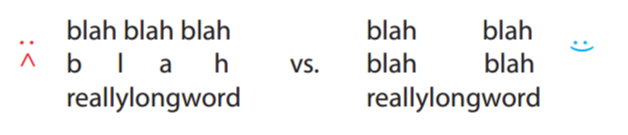
Given a text, split it into multiple lines so it is “nicely” distributed between each line.
What does it mean? Take a look at the example:
We can clearly see that eager approach won't produce good results in all cases.
Mathematically, given a badness(i, j) function for line of words[i : j], we seek for such a splitting that the sum of all badness is minimum.
Let's assume the badness function is predefined as follows:
∞ if total length > page width, else (page width − total length)3
So in the example above, the bad splitting would have:
  • page width = 16
  • first line length = 4+4+4+2 = 16, badness of the first line = 0
  • second line length = 4, badness = (16-4)3=1728
  • third line length = 16, badness = 0
  • badness sum = 1728
The good splitting would have:
  • first line length = 4+4+1 = 9, badness of the first line = (16-9)3=343
  • second line length = 9, badness = (16-9)3=343
  • third line length = 16, badness = 8
  • badness sum = 694
The second splitting has smaller total badness sum, thus it's a better splitting.

Dynamic Programming in 5 easy steps

On the MIT course, there is presented an approach to DP in 5 easy steps. Those are:
  1. define subproblems, count number of subproblems
  2. guess (part of solution), count number of choices
  3. relate subproblem solutions, compute time per subproblem
  4. recurse + memoize OR build DP table bottom-up check subproblems acyclic/topological order, time = time per subproblem · number of subproblems
  5. solve original problem: = a subproblem OR by combining subproblem solutions ⇒ extra time 
Let's try to apply them on our problem.
Well, the steps don't have to be executed always in order. Let's try to figure out the second step. We know where our line begins, it's on ith position. Where is the end of the line? We don't know. So let's check all possibilities, that's from ith onward and take the smallest badness. So now we know what's our subproblems in first step are - suffixes of word[i:]. That's pretty much the algorithm. The third step will look like:
DP(i)=for j in i+1...n+1 take
min from (DP(j) + badness(i, j))
The great thing is about DP that DP(j) considered to be free (because we compute the subproblem once and memorize the answer). Therefore the total time needed by this algorithm is:
time = time per subproblem · number of subproblems, so
time = O(n) · O(n)
time = O(n^2)
The fourth point is about proving that this really works and the time needed is finite. We compute the answer from the end of the words, down to word number 0. The recursive DP function always accesses greater indexes, therefore time needed is finite. Lastly, we have to find our answer. Here, obviously it's DP[0]. Easy? Yup, let's code it!

The code

using System;
using System.Collections.Generic;
using System.Linq;

namespace Algos
{
    public class DP_TextJustification
    {
        static void Main(String[] args)
        {
            //please note: this is not a production-ready solution!
            PrintSolution("   ", 10);
            PrintSolution("oneword", 10);
            PrintSolution("one line", 10);
            PrintSolution("two lines", 6);
            PrintSolution("blah blah blah blah reallylongword", 14);
            PrintSolution("blah blah blah blah reallylongword 1", 14);
            var txt1 = "Lorem ipsum dolor sit amet, consectetur adipiscing elit. " +
                       "Praesent varius urna eget lacinia pharetra. " +
                       "Vivamus lacinia in dui vitae sodales. " +
                       "Aliquam auctor justo nec condimentum pretium. " +
                       "Curabitur egestas tellus dolor, vel tempus lacus blandit vitae. " +
                       "Cras dapibus scelerisque ex nec gravida.";
            PrintSolution(txt1, 60);
            PrintSolution(txt1, 70);
            PrintSolution(txt1, 80);
            PrintSolution(txt1, 90);
            PrintSolution(txt1, 100);
            Console.ReadLine();
        }

        public static void PrintSolution(string txt, int width)
        {
            Console.WriteLine($"Test length: {txt.Length}, line width: {width}");
            foreach (var line in new Justifier(txt, width).Solve())
            {
                Console.WriteLine("{0,-" + width + "}|", line);
            }
            Console.WriteLine();
        }

        private class Justifier
        {
            private const int Marker = -1;
            private readonly int _width;
            private readonly string[] _words;
            private readonly int[] _parentPointers;
            private readonly int[] _memo;
             
            public Justifier(string text, int width)
            {
                _width = width;
                _words = text.Split(new[] {" "}, StringSplitOptions.RemoveEmptyEntries);
                _parentPointers = new int[_words.Length];
                _memo = new int[_words.Length];
                for (var i = 0; i < _memo.Length; i++)
                {
                    _memo[i] = Marker;
                }
            }

            public List<string> Solve()
            {
                DP(0);

                var result = new List<string>();
                var from = 0;
                while (from != _words.Length)
                {
                    var next = _parentPointers[from];
                    result.Add(string.Join(" ", _words.Skip(from).Take(next - from)));
                    from = next;
                }
                return result;
            }

            private int DP(int i)
            {
                if (i == _words.Length) //no words in line is the end of justification
                    return 0;

                if (_memo[i] != Marker) //if we have solution calculated, return it
                    return _memo[i];

                var minBadness = int.MaxValue;

                for (var j = i + 1; j <= _words.Length; j++)
                {
                    var badness = Badness(i, j) + DP(j);
                    if (minBadness > badness)
                    {
                        _parentPointers[i] = j; //remember best choice
                        minBadness = badness;
                    }
                }

                _memo[i] = minBadness; //remember solution
                return minBadness;
            }

            private int Badness(int i, int j)
            {
                var lengthOfWords = _words.Skip(i).Take(j - i).Sum(s => s.Length);
                var numberOfSpaces = j - i - 1;
                if (lengthOfWords + numberOfSpaces > _width)
                    return 10*1000*1000;
                return (int)Math.Pow(_width - lengthOfWords - numberOfSpaces, 3);
            }
        }
    }
}
To the solution in 5 easy steps I've added parent pointers - a simple way to remember the best solution from DP. The result is as follows:
If we don't care about justifying the last line, we can easily modify the badness function to return no cost for the last line:
private int Badness(int i, int j)
{
    var lengthOfWords = _words.Skip(i).Take(j - i).Sum(s => s.Length);
    var numberOfSpaces = j - i - 1;
    if (lengthOfWords + numberOfSpaces > _width)
        return 10*1000*1000;
    if (j == _words.Length) //don't care about last line
        return 0;
    return (int)Math.Pow(_width - lengthOfWords - numberOfSpaces, 3);
}
In this case, the result will be much different in some cases:

Tuesday, September 6, 2016

Cassandra Datastax C# Driver problems - solution

Please find the updated version of this post here: https://piotr.westfalewicz.com/blog/2016/09/cassandra-datastax-c-sharp-driver-problems---solution/


In the previous post I've described a strange problem related to Cassandra Datastax C# Driver which was happening once in the production environment. It's time to reveal the mystery.

Two root causes

1.

One of the hidden, but important metric, which you won't find usually in your logs is the CPU usage. What important is that the connection setup to the Cassandra cluster consists of many small steps. In production, when there was a very high CPU usage (around 100% - for reason known and already eliminated), the connection setup process was timing out in such a moment, that the final result was reported as NoHostAvailableException. This shows, how important is to track and prevent 100% CPU usage.

2.

But why, let me quote myself:
Things get back to normal after the client restart... and gets back to madness few hours later, at higher load. Incredible high number of NoHostAvailableExceptions, like almost any connection to the Cassandra fails.
The problem is here:
private readonly Cluster _cluster;
private readonly ConcurrentDictionary<string, Lazy<ISession>> _sessions; //lockless session cache

public ISession GetSession(string keyspaceName)
{
    if (!_sessions.ContainsKey(keyspaceName))
    {
        _sessions.GetOrAdd(keyspaceName, key => new Lazy<ISession>(() => _cluster.Connect(key)));
    }
    var result = _sessions[keyspaceName];
    return result.Value;
}
Do you see it? It turns out that when an exception is thrown in _cluster.Connect(key) method, the Lazy<T> will cache this exception. Therefore all invocations to Lazy<T>.Value will result in the same, cached exception instead of retrying the connection to the Cassandra cluster. If you are planning to use the Lazy<T> class, there are more "gotchas". Read the documentation on MSDN.

Lessons learned?


  1. CPU usage is very, very important and critical metric. Do not ignore it, as it may lead to numerous, strange errors.
  2. RTFM! Read the documentation when using any class for the first time. Especially when copying&pasting code from the StackOverflow.

Tuesday, August 30, 2016

Cassandra Datastax C# Driver problems - NoHostAvailableException

Please find the updated version of this post here: https://piotr.westfalewicz.com/blog/2016/08/cassandra-datastax-c-sharp-driver-problems---nohostavailableexception/


This post will be about my journey with fixing nasty Cassandra Datastax C# driver problem, which took me a lot more time than expected...
Credits: wikimedia

Once upon a time, I've been fixing following exception:
Cassandra.NoHostAvailableException: None of the hosts tried for query are available (tried: x.x.x.x:9042, x.x.x.x:9042, x.x.x.x:9042)
   at Cassandra.ControlConnection.Connect(Boolean firstTime)
   at Cassandra.Cluster.Connect(String keyspace)
   at Company.Code.CassandraSessionCache.GetSession(String keyspaceName)
   at Company...
The CassandraSessionCache looked like this:
public class CassandraSessionCache
{
    private readonly Cluster _cluster;
    private readonly ConcurrentDictionary<string, Lazy<ISession>> _sessions; //lockless session cache

    public CassandraSessionCache(Cluster cluster)
    {
        _cluster = cluster;
        _sessions = new ConcurrentDictionary<string, Lazy<ISession>>();
    }

    public ISession GetSession(string keyspaceName)
    {
        if (!_sessions.ContainsKey(keyspaceName))
        {
   _sessions.GetOrAdd(keyspaceName, key => new Lazy<ISession>(() => _cluster.Connect(key)));
        }
        var result = _sessions[keyspaceName];
        return result.Value;
    }
}
Nothing fancy, however let me give you an insight about the architecture and circumstances of the error:
  • Cassandra cluster is in Amazon
  • The client is Cassandra Datastax C# Driver 2.6.0, also on server in Amazon
  • Both the client and the Cassandra cluster is the same Amazon Region
  • Amazon Region had no availability issues during given period
  • The solution was working fine for over 1 month! The client process is being restarted ~every week for various reasons
  • The client follows Cassandra Datastax C# Driver Best Practices
  • Heartbeat is turned on, so the connection should be alive, all the times
  • Things get back to normal after the client restart... and gets back to madness few hours later, at higher load. Incredible high number of NoHostAvailableExceptions, like almost any connection to the Cassandra fails.
  • Of course, it works on my machine®

What didn't happen?

There are plenty of questions about Cassandra.NoHostAvailableException on StackOverflow. So let's get through some of them and exclude them:
  • [1][2] - no, because following C# Driver best practices excludes this
  • [3] - no, because we are using default retry strategy from driver version 2.6.0
  • [4][5][6] - no, because we are able to connect to the Cluster at the beginning
  • [7] - no, because we are not misusing batches

Debugging...

Logs on server revealed that the client closed the connection:
INFO  [SharedPool-Worker-3] yyyy-mm-dd 11:04:45,625 Message.java:605 - Unexpected exception during request; channel = [id: 0x9eaf52c5, /x.x.x.x:y :> /x.x.x.x:9042]
java.io.IOException: Error while read(...): Connection reset by peer
  at io.netty.channel.epoll.Native.readAddress(Native Method) ~[netty-all-4.0.23.Final.jar:4.0.23.Final]
  at io.netty.channel.epoll.EpollSocketChannel$EpollSocketUnsafe.doReadBytes(EpollSocketChannel.java:675) ~[netty-all-4.0.23.Final.jar:4.0.23.Final]
  at io.netty.channel.epoll.EpollSocketChannel$EpollSocketUnsafe.epollInReady(EpollSocketChannel.java:714) ~[netty-all-4.0.23.Final.jar:4.0.23.Final]
  at io.netty.channel.epoll.EpollSocketChannel$EpollSocketUnsafe.epollRdHupReady(EpollSocketChannel.java:689) ~[netty-all-4.0.23.Final.jar:4.0.23.Final]
 at io.netty.channel.epoll.EpollEventLoop.processReady(EpollEventLoop.java:329) ~[netty-all-4.0.23.Final.jar:4.0.23.Final]
 at io.netty.channel.epoll.EpollEventLoop.run(EpollEventLoop.java:264) ~[netty-all-4.0.23.Final.jar:4.0.23.Final]
 at io.netty.util.concurrent.SingleThreadEventExecutor$2.run(SingleThreadEventExecutor.java:116) ~[netty-all-4.0.23.Final.jar:4.0.23.Final]
 at io.netty.util.concurrent.DefaultThreadFactory$DefaultRunnableDecorator.run(DefaultThreadFactory.java:137) ~[netty-all-4.0.23.Final.jar:4.0.23.Final]
 at java.lang.Thread.run(Thread.java:745) [na:1.7.0_80]
While the message on the client says that there are no hosts available, what is confirmed by debug logs on the client side. Pretty interesting, huh? Being confused, I've decided to give an update from 2.6.3 to 2.7 a try... but that didn't help.
Accoring to yet another issue regarding NoHostsAvailableException on StackOverflow I've started to log whole exception, with serialized errors property. This is what I've logged:
System.Exception: NoHostAvailableException happened. Errors: {
  "x.x.x.x:9042": {
    "NativeErrorCode": 10060,
    "ClassName": "System.Net.Sockets.SocketException",
    "Message": "A connection attempt failed because the connected party did not properly respond after a period of time, or established connection failed because connected host has failed to respond",
    "Data": null,
    "InnerException": null,
    "HelpURL": null,
    "StackTraceString": "   
  at Cassandra.Connection.<Open>b__9(Task`1 t)
  at System.Threading.Tasks.ContinuationResultTaskFromResultTask`2.InnerInvoke()
  at System.Threading.Tasks.Task.Execute()",
    "RemoteStackTraceString": null,
    "RemoteStackIndex": 0,
    "ExceptionMethod": "8\n<Open>b__9\nCassandra, Version=2.7.0.0, Culture=neutral, PublicKeyToken=10b231fbfc8c4b4d\nCassandra.Connection\nCassandra.AbstractResponse <Open>b__9(System.Threading.Tasks.Task`1[Cassandra.AbstractResponse])",
    "HResult": -2147467259,
    "Source": "Cassandra",
    "WatsonBuckets": null
  },
  "x.x.x.x:9042": {
    "NativeErrorCode": 10060,
    "ClassName": "System.Net.Sockets.SocketException",
    "Message": "A connection attempt failed because the connected party did not properly respond after a period of time, or established connection failed because connected host has failed to respond",
    "Data": null,
    "InnerException": null,
    "HelpURL": null,
    "StackTraceString": "
  at Cassandra.Connection.<Open>b__9(Task`1 t)
  at System.Threading.Tasks.ContinuationResultTaskFromResultTask`2.InnerInvoke()
  at System.Threading.Tasks.Task.Execute()",
    "RemoteStackTraceString": null,
    "RemoteStackIndex": 0,
    "ExceptionMethod": "8\n<Open>b__9\nCassandra, Version=2.7.0.0, Culture=neutral, PublicKeyToken=10b231fbfc8c4b4d\nCassandra.Connection\nCassandra.AbstractResponse <Open>b__9(System.Threading.Tasks.Task`1[Cassandra.AbstractResponse])",
    "HResult": -2147467259,
    "Source": "Cassandra",
    "WatsonBuckets": null
  }
}
Unfortunately, no interesting data is here.

So what could possibly go wrong?

Can you spot the error? I couldn't. Any guesses? Find the answer in next post.

Thursday, August 18, 2016

Algorithms and data structures - non-academic trees

Please find the updated version of this post here: https://piotr.westfalewicz.com/blog/2016/08/algorithms-and-data-structures---non-academic-trees/

Credits: Wikipedia Tree (data structure)
There are many types of trees which are covered on Computer Science lectures. Those usually include: Binary Search Tree, AVL Tree, B Tree, Splay Tree, Red-Black Tree, Trie Trees, Heap Trees.

Those are indeed very useful and practical trees with lots of applications. However, I've discovered few other trees while brushing up my knowledge about algorithms and data structures. Here they are, the most interesting, yet not so popular trees:
  • BK-Tree - do you want to find misspellings of a word in a dictionary? E.g. given word "dog" and dictionary { "cat", "fog", "dot", "cookie" }, naive approach is to compare the word "dog" to all of the entries in the dictionary. This leads to O(n) time. It can be solved in O(lg n) time, though. Burkhard-Keller tree is used in Apache Lucene, for example. Head to Xenopax's Blog for awesome post about BK-Trees.
  • Merkle Tree - probably you didn't know but that's the name of the tree of commits and blobs in a Git VCS. Another applications known to me personally include: Cassandra (during node repair) and Bitcoin blockchain.
  • Interval Tree - interesting idea of augmenting "normal" (single value) trees with additional data in order to solve windowing queries.
  • Lemon Tree - the most complicated type of tree. Many wondered what it really is, but few actually knew... Find the official statement here.

Tuesday, July 26, 2016

The performance of setting T[] vs. List by index

Source: wikimedia.org

Let's compare asymptotic time complexity of two following loops:
int[] _array = Enumerable.Range(0, n).ToArray();
List<int> _list = Enumerable.Range(0, n).ToList();

//ListChangeByIndex
for (var i = 0; i < n; i++)
{
    _list[i] = i + 1;
}

//ArrayChangeByIndex
for (var i = 0; i < n; i++)
{
    _array[i] = i + 1;
}
How do you think, which one is faster?
.
.
.
.
.
.
.
.
Many developers think the fist one will be slower, because in each loop computer is forced to visit all nodes from 0 to i to finally set the variable.
However, that's not the case. Both loops have O(n) complexity. That's because in the .NET source we can clearly see that's underlying data structure for a List<T> is an array: list.cs. Therefore, those two loops are essentially equal.

Tuesday, July 12, 2016

Presentation recommendation - Cloud-based Microservices powering BBC iPlayer

Today I recommend you following presentation: Cloud-based Microservices powering BBC iPlayer

Why? It's interesting (at least for me) how one of the most popular British broadcasting organisation make their's channels available online. A high-level architecture is presented. If you are new to AWS, you will also learn a thing or two about the Amazon Cloud.

Thursday, June 30, 2016

Git tips - replace all occurrences of a string in files


Git can be used from VisualStudio, however it's like saying you drive a car, when actually you play Need for Speed. Unleash the full power of Git, learn to use it. It's not that hard.

Doesn't matter if you are a beginner or an advanced user, you should know what an git alias is. If you don't know, go here immediately: Git Basics - Git Aliases.

Today, you will get a very useful git alias. It's for replacing all occurrences of one string with another. Suppose you want to replace EntityFramework with NHibernate in your project (which seems to be a pretty reasonable thing to do:) ). Here is the alias:
replaceall = "!f() { git grep -l \"$1\" | xargs sed -b -i \"s/$1/$2/g\"; }; f"
The first part of the alias lists all files containing first argument and passes it through pipe and xargs to sed, which performs the replacement. Use it like this:
git replaceall EntityFramework NHibernate
 Please note: it will replace all occurrences of "EntityFramework" with "NHibernate" in all tracked and untracked files.

Monday, June 13, 2016

Messing with C# types. Making type1.FullName==type2.FullName, but not type1==type2!

Please find the updated version of this post here: https://piotr.westfalewicz.com/blog/2016/07/the-performance-of-setting-t-vs.-list-by-index/


Given the following method:
private static void CompareTypes(Type type1, Type type2)
{
    Console.WriteLine($"type1.FullName = {type1.FullName}");
    Console.WriteLine($"type2.FullName = {type2.FullName}");
    Console.WriteLine($"type1.FullName {(type1.FullName == type2.FullName ? '=' : '!')}= type2.Fullname");
    Console.WriteLine($"type1.AssemblyQualifiedName = {type1.AssemblyQualifiedName}");
    Console.WriteLine($"type2.AssemblyQualifiedName = {type2.AssemblyQualifiedName}");
    Console.WriteLine($"type1.AssemblyQualifiedName {(type1.AssemblyQualifiedName == type2.AssemblyQualifiedName ? '=' : '!')}= type2.AssemblyQualifiedName");
    Console.WriteLine($"type1.GUID = {type1.GUID}");
    Console.WriteLine($"type2.GUID = {type2.GUID}");
    Console.WriteLine($"type1.GUID {(type1.GUID == type2.GUID ? '=' : '!')}= type2.GUID");

    Console.WriteLine("o1 = Activator.CreateInstance(type1)");
    Console.WriteLine("o2 = Activator.CreateInstance(type2)");
    var o1 = Activator.CreateInstance(type1);
    var o2 = Activator.CreateInstance(type2);
    Console.WriteLine($"o1 == {o1}");
    Console.WriteLine($"o2 == {o2}");

    Console.WriteLine();
    Console.WriteLine($"but... type1 {(type1 == type2 ? '=' : '!')}= type2");
}
Is it possible to get the following result?
type1.FullName = MyLibrary.MyPrecious
type2.FullName = MyLibrary.MyPrecious
type1.FullName == type2.Fullname
type1.AssemblyQualifiedName = MyLibrary.MyPrecious, MyLibrary, Version=1.0.0.0, Culture=neutral, PublicKeyToken=null
type2.AssemblyQualifiedName = MyLibrary.MyPrecious, MyLibrary, Version=1.0.0.0, Culture=neutral, PublicKeyToken=null
type1.AssemblyQualifiedName == type2.AssemblyQualifiedName
type1.GUID = cacf8c0d-b903-3da6-808f-024a3070ab9d
type2.GUID = cacf8c0d-b903-3da6-808f-024a3070ab9d
type1.GUID == type2.GUID
o1 = Activator.CreateInstance(type1)
o2 = Activator.CreateInstance(type2)
o1 == MyLibrary.MyPrecious
o2 == MyLibrary.MyPrecious

but... type1 != type2
As it turns out, it is. Doing such a hell is relatively easy:
private static Assembly LoadAssemblyByName(string name)
{
    var myPreciousAssemblyLocation = Path.Combine(Path.GetDirectoryName(Assembly.GetExecutingAssembly().Location), name);
    using (var fs = new FileStream(myPreciousAssemblyLocation, FileMode.Open, FileAccess.Read))
    {
        var data = new byte[fs.Length];
        fs.Read(data, 0, data.Length);
        fs.Close();
        var assembly = Assembly.Load(data);
        return assembly;
    }
}

static void Main()
{
    var type1 = typeof (MyPrecious);
    var myLibraryAssembly = LoadAssemblyByName("MyLibrary.dll");
    var type2 = myLibraryAssembly.GetType("MyLibrary.MyPrecious", true);

    CompareTypes(type1, type2);
}
The code above compares type1 from referenced project to type2 from the same assembly, but loaded again through Assembly.Load(byte[]). That makes the library loaded twice in the AppDomain. Now when a call to AppDomain.CurrentDomain.GetAssemblies() is made, the assemblies are:
AppDomain.CurrentDomain.GetAssemblies:
mscorlib, Version=4.0.0.0, Culture=neutral, PublicKeyToken=b77a5c561934e089
Microsoft.VisualStudio.HostingProcess.Utilities, Version=14.0.0.0, Culture=neutral, PublicKeyToken=b03f5f7f11d50a3a
System.Windows.Forms, Version=4.0.0.0, Culture=neutral, PublicKeyToken=b77a5c561934e089
System, Version=4.0.0.0, Culture=neutral, PublicKeyToken=b77a5c561934e089
System.Drawing, Version=4.0.0.0, Culture=neutral, PublicKeyToken=b03f5f7f11d50a3a
Microsoft.VisualStudio.HostingProcess.Utilities.Sync, Version=14.0.0.0, Culture=neutral, PublicKeyToken=b03f5f7f11d50a3a
Microsoft.VisualStudio.Debugger.Runtime, Version=14.0.0.0, Culture=neutral, PublicKeyToken=b03f5f7f11d50a3a
vshost32, Version=14.0.0.0, Culture=neutral, PublicKeyToken=b03f5f7f11d50a3a
System.Core, Version=4.0.0.0, Culture=neutral, PublicKeyToken=b77a5c561934e089
ConsoleApplication1, Version=1.0.0.0, Culture=neutral, PublicKeyToken=null
MyLibrary, Version=1.0.0.0, Culture=neutral, PublicKeyToken=null
Accessibility, Version=4.0.0.0, Culture=neutral, PublicKeyToken=b03f5f7f11d50a3
Even in such a small, console application it is quite confusing. So, let's make it more confusing... What's the output of the following code?
var myPreciousAssemblyLocation = Path.Combine(Path.GetDirectoryName(Assembly.GetExecutingAssembly().Location), "MyLibrary.dll");
var myLibraryAssemblyLoadFrom = Assembly.LoadFrom(myPreciousAssemblyLocation);
var type3 = myLibraryAssemblyLoadFrom.GetType("MyLibrary.MyPrecious", true);
CompareTypes(type1, type3);
Now, surprisingly, its:
type1.FullName = MyLibrary.MyPrecious
type2.FullName = MyLibrary.MyPrecious
type1.FullName == type2.Fullname
type1.AssemblyQualifiedName = MyLibrary.MyPrecious, MyLibrary, Version=1.0.0.0, Culture=neutral, PublicKeyToken=null
type2.AssemblyQualifiedName = MyLibrary.MyPrecious, MyLibrary, Version=1.0.0.0, Culture=neutral, PublicKeyToken=null
type1.AssemblyQualifiedName == type2.AssemblyQualifiedName
type1.GUID = cacf8c0d-b903-3da6-808f-024a3070ab9d
type2.GUID = cacf8c0d-b903-3da6-808f-024a3070ab9d
type1.GUID == type2.GUID
o1 = Activator.CreateInstance(type1)
o2 = Activator.CreateInstance(type2)
o1 == MyLibrary.MyPrecious
o2 == MyLibrary.MyPrecious

but... type1 == type2

Hint

A nice hint is shown, when you try to execute the following code:
var o1 = Activator.CreateInstance(type1);
var o2 = Activator.CreateInstance(type2);
MyPrecious p1 = (MyPrecious) o1;
try
{
    MyPrecious p2 = (MyPrecious)o2;
}
catch (Exception e)
{
    Console.WriteLine(e);
}
System.InvalidCastException: [A]MyLibrary.MyPrecious cannot be cast to [B]MyLibrary.MyPrecious. Type A originates from 'MyLibrary, Version=1.0.0.0, Culture=neutral, PublicKeyToken=null' in the context 'LoadNeither' in a byte array. Type B originates from 'MyLibrary, Version=1.0.0.0, Culture=neutral, PublicKeyToken=null' in the context 'Default' at location 'c:\users\pwdev\documents\visual studio 2015\Projects\ConsoleApplication1\ConsoleApplication1\bin\Debug\MyLibrary.dll'. at ConsoleApplication1.Program.Main() in c:\users\pwdev\documents\visual studio 2015\Projects\ConsoleApplication1\ConsoleApplication1\Program.cs:line 49

Explanation

Yes, it's all about the load contexts. There are three different assembly load contexts: Load, LoadFrom, Neither. Usually there is no need to load the same library twice and get the strange behavior written above, but sometimes there might be. There are many advantages and disadvantages of using different Assembly.Load(From/File) methods. Take a look: Choosing a Binding Context. Furthermore, consider what's happening to assembly dependencies when you load an assembly. There are best practices described on MDSN for loading assemblies: Best Practices for Assembly Loading. I have to say, in my whole career I've been loading assemblies by hand twice, and from time perspective, both two cases were wrong.

TypeHandle

Instead of comparing the types in the examples above by == operator, there is a possibility to compare them by the TypeHandle:
TypeHandle encapsulates a pointer to an internal data structure that represents the type. This handle is unique during the process lifetime. The handle is valid only in the application domain in which it was obtained.
Source: MDSN. Well, I can't think of an interesting usage for the TypeHandles for now, but it's good to know.